
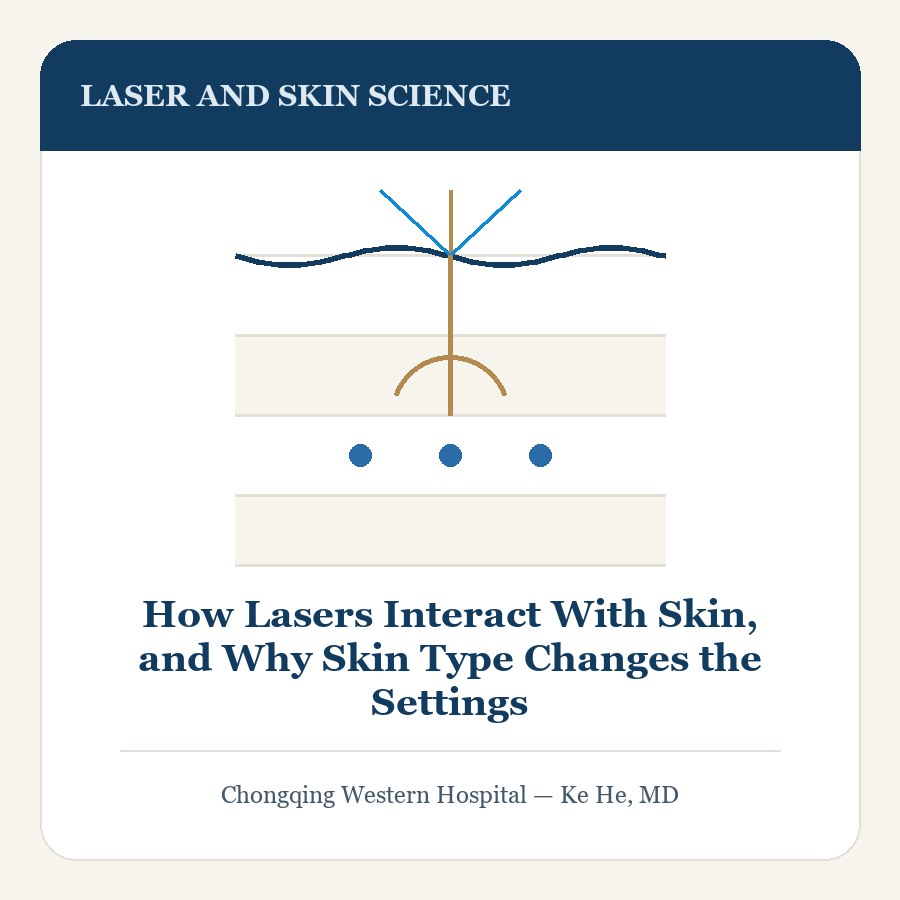
In short. Selective photothermolysis explained plainly, and how Fitzpatrick skin type changes laser settings, intervals, and safety margins in darker skin.
Key points
- Two people with the same Fitzpatrick type can respond differently, because recent sun exposure, tanning, medication, hormones, and a personal history of pigmentation or scarring all shift the risk.
- The scale informs the plan; the examination decides it.
- That is why the same concern produces different settings in different people — and why treating a laser like a vending machine is where most complications begin.
Almost every honest conversation about laser treatment comes back to two ideas: what the light is absorbed by, and what your skin does with the heat that follows. Between them they explain most of what patients are told about settings, intervals, and risk.
Selective photothermolysis, in plain words
Laser and light devices deliver energy at particular wavelengths. In skin, that energy is absorbed preferentially by a small number of targets: melanin in pigment-producing cells and hair, haemoglobin in blood vessels, and water in the surrounding tissue. If the pulse is short enough, and the wavelength is absorbed far more strongly by the target than by its neighbours, the target can be heated enough to be damaged while the surrounding skin is largely spared. This principle is called selective photothermolysis, and it is the reason a pigment laser can clear a freckle without burning the cheek it sits on.
Two variables decide whether that works. Wavelength sets which target absorbs the energy. Pulse duration sets how tightly the heat is confined: pulses shorter than the target’s own cooling time damage the target, while longer pulses let heat spread, which is useful for bulk heating but far less selective.
Why skin type changes the settings
The Fitzpatrick scale groups skin from type I, which burns easily and never tans, to type VI, which is deeply pigmented. It matters because melanin is a target the device cannot ignore. In darker skin, the natural pigment in the surrounding skin absorbs the same wavelengths intended for the target, so the margin between effective and harmful narrows sharply. Settings that are routine in type I or II skin can cause burns, blistering, or post-inflammatory pigmentation in type IV or V.
The response is not to avoid treatment but to change it: longer wavelengths that melanin absorbs less, longer pulse durations, lower fluence, effective cooling, and often more sessions at gentler settings. Some pigment lasers carry meaningful risk in darker skin regardless of settings, and a physician should say so.
Skin type is a starting point, not a verdict
Two people with the same Fitzpatrick type can respond differently, because recent sun exposure, tanning, medication, hormones, and a personal history of pigmentation or scarring all shift the risk. The scale informs the plan; the examination decides it. That is why the same concern produces different settings in different people — and why treating a laser like a vending machine is where most complications begin.
What this means for you
Expect a physician to look at your skin before discussing settings, to ask about recent sun or tanning, and to propose a test area or a staged course rather than a single aggressive session. Expect to be told that the number of sessions is an estimate, not a promise. And expect an honest answer when a device is a poor fit for your skin type rather than an adjustable one.
Speak up before treatment if any of these apply
- You have tanned, used a sunbed, or been sunburnt in the past two to four weeks — it changes both the settings and the risk.
- You have darker skin, or a personal or family history of melasma, keloid, or raised scarring.
- You take any medicine that makes skin photosensitive, or you are pregnant or breastfeeding.
Frequently asked questions
What does selective photothermolysis mean in everyday language?
Energy at a chosen wavelength is absorbed far more strongly by a target such as melanin or haemoglobin than by the surrounding skin. If the pulse is short enough, the target is heated enough to be damaged while the neighbouring skin is largely spared.
Why does skin type change the laser settings?
In darker skin the surrounding melanin absorbs the same wavelengths intended for the target, narrowing the margin between an effective dose and a harmful one. The response is longer wavelengths, longer pulses, lower fluence, cooling, and often more sessions at gentler settings.
Does the same skin type always mean the same plan?
No. Recent sun exposure, tanning, medication, hormones and a personal history of pigmentation or scarring all shift the risk. The scale informs the plan while the examination decides it, which is why the same concern produces different settings in different people.
Risks & Limitations
- Burns and blistering if settings do not match the skin.
- Post-inflammatory hyperpigmentation, particularly in darker skin types, which may take months to settle.
- Hypopigmentation (lightening) of treated skin, which can be permanent.
- Scarring, including hypertrophic scarring, which is uncommon but real.
- Infection, including reactivation of herpes simplex after resurfacing.
- Acne or milia flare during recovery.
- Results are incremental and most concerns need several sessions. Melasma may rebound or worsen with aggressive treatment.
When to Seek Care
- Blistering, weeping or broken skin beyond the expected reaction.
- Severe pain that is worsening rather than settling.
- Spreading redness, warmth, pus or fever.
- New darkening or firmness that looks like scarring at the treated area.
- Any change in a treated pigmented lesion — it should be reviewed, not retreated.
References & Further Reading
- American Academy of Dermatology (AAD) — laser and energy device information
- American Society for Laser Medicine & Surgery (ASLMS)
- National Medical Products Administration (NMPA, China) — device registration status
- Cochrane Library — systematic reviews in laser dermatology
This page is patient education, not medical advice, and it does not cite individual studies. Discuss your own case with a qualified clinician. To arrange an assessment at Chongqing West District Hospital, see Contact & Consultation.