
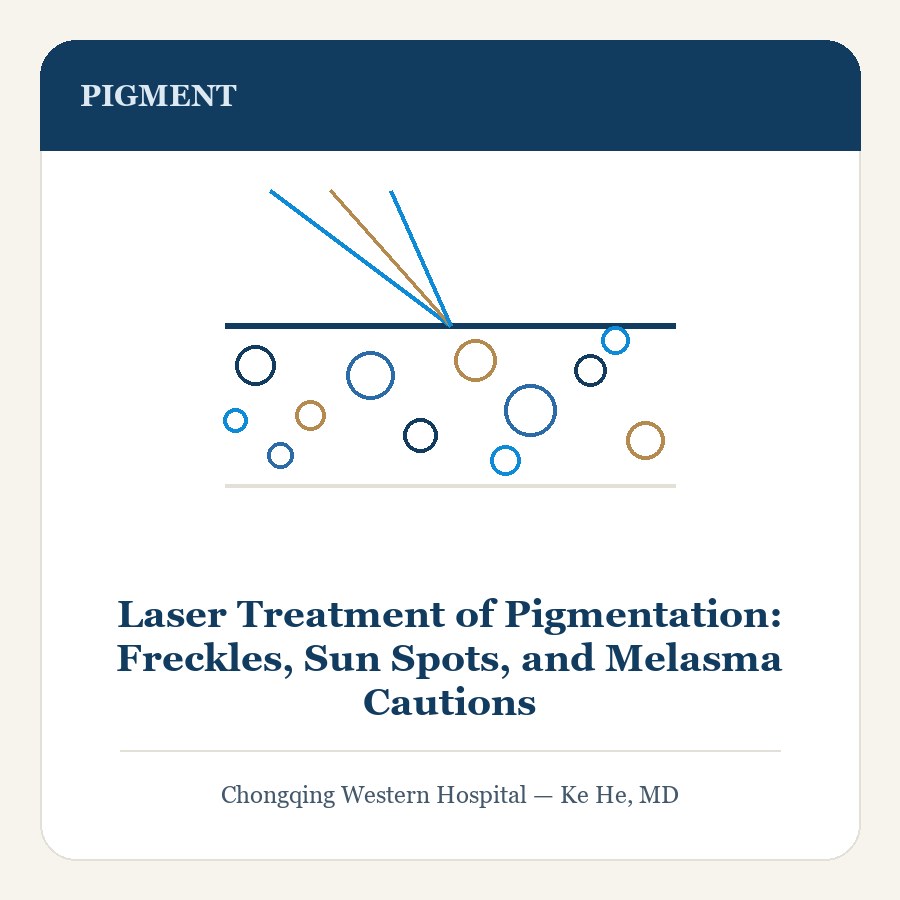
In short. How lasers clear freckles and sun spots, why pigment must be diagnosed before it is treated, and why melasma is a caution rather than a routine laser target.
Key points
- Melasma is a reactive, hormone- and light-sensitive condition in which pigment-producing cells are chronically overactive.
- Aggressive laser treatment commonly makes it temporarily lighter and then worse, sometimes permanently, because the inflammation itself drives more pigment.
- First-line management is sun protection, topical agents, and time.
Brown patches look alike and behave nothing alike. Freckles, sun spots, melasma, and post-inflammatory pigment sit at different depths, have different causes, and respond to lasers in opposite ways. The single most useful thing a laser physician does with pigment is not treat it, but identify it.
The pigment that clears well
Freckles and sun spots are collections of pigment in the upper skin, generated by ultraviolet exposure. They sit close to the surface, are sharply defined, and absorb short-wavelength light strongly. Q-switched and picosecond lasers clear them reliably in a small number of sessions, and intense pulsed light can fade diffuse sun damage across a broader area. Treated spots typically darken and flake away over about a week. Tattoo removal and the removal of certain benign pigmented lesions use the same principle with different wavelengths and pulse durations.
Why the diagnosis comes first
Not every brown lesion is cosmetic. Some pigmented lesions are benign but unsuitable for lasers, and a small number are malignant. Any lesion that is new, changing in size, shape, or colour, bleeding, itching, or asymmetric should be examined and, where indicated, excised rather than lasered. This is a clinical rule rather than a formality: a melanoma treated as a cosmetic blemish delays diagnosis, and that delay has real consequences.
Melasma is different, and a laser is not its first answer
Melasma is a reactive, hormone- and light-sensitive condition in which pigment-producing cells are chronically overactive. Aggressive laser treatment commonly makes it temporarily lighter and then worse, sometimes permanently, because the inflammation itself drives more pigment. First-line management is sun protection, topical agents, and time. If a laser is used at all, it is low-energy, cautious, and an addition to — never a replacement for — the treatment that controls the condition.
Aftercare decides the result
Because pigment cells react to inflammation, how you protect treated skin in the weeks afterwards matters as much as the settings used. Strict daily sun protection, gentle cleansing, and leaving flaking spots alone are the difference between a clean result and a patch of post-inflammatory pigmentation that takes months to settle. Treated pigment sometimes returns, because the underlying tendency to produce it has not changed. Repeating a course is possible; repeating it without addressing sun exposure is not a plan.
Seek review rather than another session if
- A pigmented lesion is changing, bleeding, or looks different from the others around it.
- Treated skin becomes darker rather than lighter, or stays dark after the flaking has finished.
- Redness, pain, or blistering develops after a session — inflammation is the main driver of pigment problems.
Frequently asked questions
Why must a pigmented lesion be diagnosed before it is lasered?
Because a small number are malignant. Any lesion that is new, changing in size, shape or colour, bleeding, itching or asymmetric should be examined and, where indicated, excised rather than lasered. Treating a melanoma as a cosmetic blemish delays diagnosis.
Why is melasma a caution rather than a routine laser target?
Melasma is a reactive, hormone- and light-sensitive condition in which pigment-producing cells are chronically overactive. Aggressive laser treatment commonly makes it temporarily lighter and then worse, because the inflammation itself drives more pigment. Protection and topical treatment lead instead.
What does aftercare decide after pigment laser treatment?
Because pigment cells react to inflammation, daily sun protection, gentle cleansing and leaving flaking spots alone separate a clean result from post-inflammatory pigmentation that takes months to settle. Treated pigment can also return, because the underlying tendency has not changed.
Risks & Limitations
- Burns and blistering if settings do not match the skin.
- Post-inflammatory hyperpigmentation, particularly in darker skin types, which may take months to settle.
- Hypopigmentation (lightening) of treated skin, which can be permanent.
- Scarring, including hypertrophic scarring, which is uncommon but real.
- Infection, including reactivation of herpes simplex after resurfacing.
- Acne or milia flare during recovery.
- Results are incremental and most concerns need several sessions. Melasma may rebound or worsen with aggressive treatment.
When to Seek Care
- Blistering, weeping or broken skin beyond the expected reaction.
- Severe pain that is worsening rather than settling.
- Spreading redness, warmth, pus or fever.
- New darkening or firmness that looks like scarring at the treated area.
- Any change in a treated pigmented lesion — it should be reviewed, not retreated.
References & Further Reading
- American Academy of Dermatology (AAD) — laser and energy device information
- American Society for Laser Medicine & Surgery (ASLMS)
- National Medical Products Administration (NMPA, China) — device registration status
- Cochrane Library — systematic reviews in laser dermatology
This page is patient education, not medical advice, and it does not cite individual studies. Discuss your own case with a qualified clinician. To arrange an assessment at Chongqing West District Hospital, see Contact & Consultation.